College basketball becomes exciting when March gets closer. Fans start checking team records, rankings, and tournament chances. At this time, one name often appears in basketball discussions: Jerry Palm.
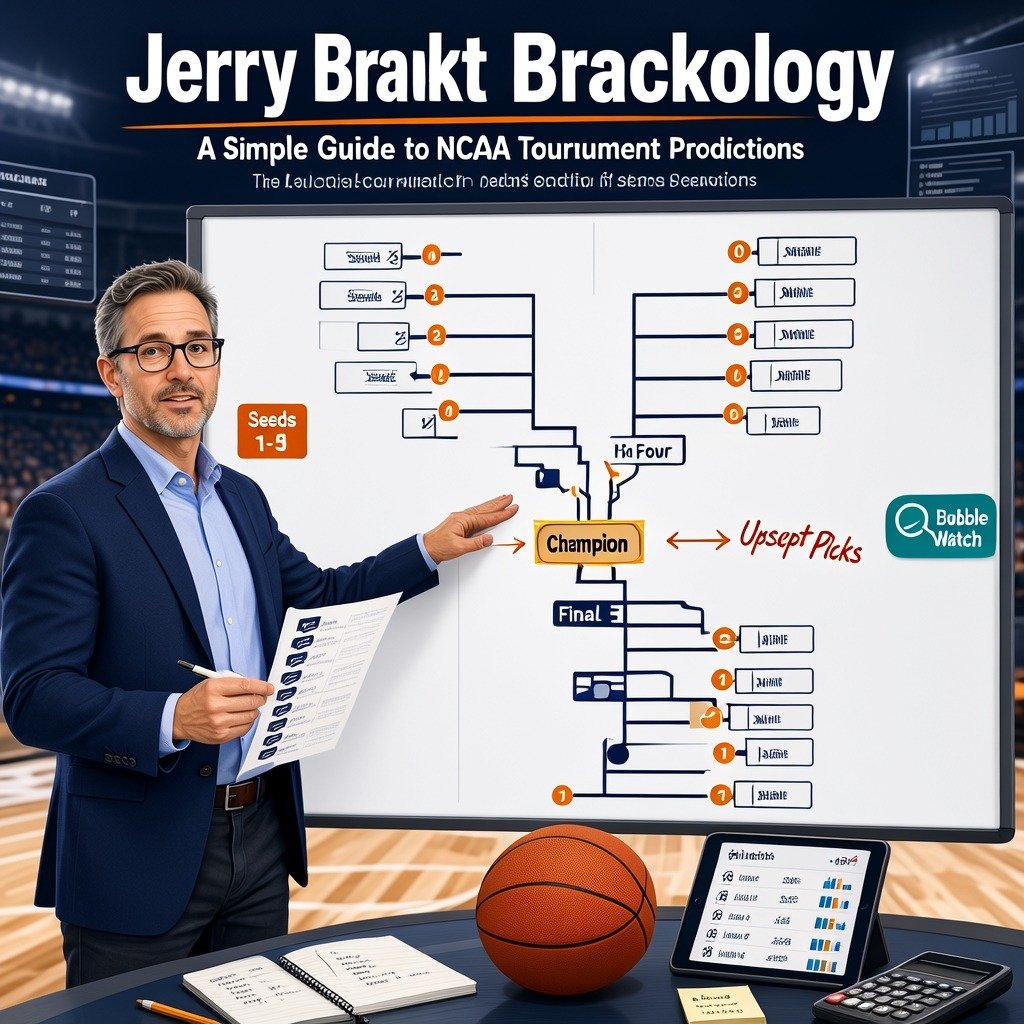
Jerry Palm is known for his work as a bracketologist. He studies college basketball teams and creates projected NCAA Tournament brackets. His work helps fans understand how the tournament field may look.
If you search for jerry palm bracketology, you may want to know how his brackets work. You may also want to understand how teams move up or down.
This guide explains the topic in simple language. It covers bracketology, NCAA selection, team resumes, seed lines, bubble teams, and more.
What Is Jerry Palm Bracketology?
Jerry Palm bracketology is connected to Jerry Palm’s work projecting the NCAA Tournament field. He has spent many years studying college basketball. He is known as a CBS Sports bracketologist.
Bracketology means making a projected tournament bracket before the official bracket comes out. The goal is not simply to rank teams. Instead, a bracketologist tries to estimate how the NCAA selection committee may build the field.
Jerry Palm has explained that his projected bracket represents what he thinks the bracket would look like if the season ended at that moment. Therefore, his projection can change after every important game.
That point is important. A bracket projection is not the official NCAA bracket. It is an educated projection based on available information.
Who Is Jerry Palm?
Jerry Palm is a sports analyst and bracketologist. CBS Sports identifies him as its bracketology and College Football Playoff expert. His work includes NCAA Tournament projections and analysis.
Palm has worked with basketball statistics for many years. CBS Sports describes him as one of the pioneers of predicting the March Madness bracket.
His long experience gives him a strong understanding of the selection process. However, his bracket remains a projection. The official NCAA Tournament bracket comes from the selection committee.
Why Do Fans Search for Jerry Palm Bracketology?
Many fans want to know if their favorite team can reach March Madness. They may also want to know where that team could be seeded.
That is why jerry palm bracketology gets attention during the college basketball season. Fans can look at a projected field and see where teams currently stand.
Also, bracketology makes the season more interesting. Every big win can change the picture. Likewise, a bad loss can hurt a team’s position.
Fans also enjoy watching bubble teams. These teams sit near the edge of the projected field. Their final games can become very important.
How Does Bracketology Work?
Bracketology starts with information about college basketball teams. A bracketologist studies wins, losses, opponents, schedules, and other useful data.
The process also considers the NCAA’s selection methods. The committee uses several pieces of information when comparing teams.
Jerry Palm has explained that the NCAA selection process uses the NET and other team information. However, statistics do not make the final decision by themselves. The selection committee makes the official choices.
Therefore, jerry palm bracketology should be viewed as a projection of the committee’s possible thinking. It is not a replacement for the actual selection process.
What Is the NCAA Tournament?
The NCAA Tournament is the major postseason tournament for Division I men’s college basketball. Fans often call it March Madness.
The tournament includes 68 teams. Those teams are placed into a large bracket.
Some teams receive automatic bids. Others receive at-large bids. The selection committee chooses the at-large teams and assigns seeds.
The bracket then creates a path toward the national championship. Teams must win games to keep moving forward.
What Does a Bracketologist Predict?
A bracketologist usually predicts more than which teams make the tournament.
The projection can include:
- Teams expected to receive bids
- Seed positions
- Regions
- First Four matchups
- Bubble teams
- Teams near the cut line
- Possible conference representation
A bracketologist also watches how results affect the overall field.
For example, one major upset can change several seed lines. It can also affect teams near the bubble.
That is why jerry palm bracketology can change quickly during March.
What Is a Seed?
A seed is a number given to a team in the NCAA Tournament bracket.
Each region has teams seeded from No. 1 through No. 16. The No. 1 seeds sit at the top of their regions.
However, a lower seed does not automatically mean a team is weak. Tournament games can produce surprises.
The seed mainly shows where the selection committee placed a team. It also helps create the tournament matchups.
Understanding Seed Lines
Basketball fans often hear terms such as “top line” or “No. 1 seed line.”
A seed line groups teams by their projected seed. For example, a bracketologist may place four teams on the No. 1 seed line.
The next group sits on the No. 2 line. Then come the No. 3 seeds and so on.
This makes bracketology easier to follow. Fans can quickly see which teams have strong projected positions.
What Is the Bubble?
The bubble is one of the most exciting parts of bracketology.
Bubble teams are teams that may or may not make the NCAA Tournament. Their position can change after important games.
A team may move into the field after a big win. On the other hand, it may fall out after a bad loss.
The bubble becomes especially important near Selection Sunday. At that point, only a few games remain.
Jerry Palm regularly discusses teams around the tournament cut line. His CBS Sports work includes bubble analysis and projected fields.
What Does “First Four Out” Mean?
“First Four Out” is a common bracketology term.
It usually refers to teams that sit just outside the projected tournament field.
These teams are close. However, they are not currently projected to receive an at-large bid.
Their situation can change quickly. A strong win may push a team into the field.
Meanwhile, a loss by another bubble team can also create an opening.
What Are Automatic Bids?
Automatic bids are tournament spots earned through conference tournament championships.
Many conferences hold tournaments at the end of the regular season.
The conference tournament winner receives an automatic NCAA Tournament bid.
Bracketologists must account for these bids when creating a projected field.
Jerry Palm has explained that his projections are based on the idea that the season has ended at the current point. Because of that, conference leaders can be used as projected automatic qualifiers before the actual tournament champions are known.
What Are At-Large Bids?
At-large bids are given to teams that do not receive automatic bids.
The selection committee compares these teams using their overall tournament resumes.
This is where things become difficult.
Two teams can have similar records but very different schedules. One may have strong wins. Another may have better road results.
Therefore, a simple win-loss record does not tell the whole story.
Why Strength of Schedule Matters
Strength of schedule shows how difficult a team’s schedule has been.
A team that plays strong opponents has more chances to earn valuable wins.
However, playing difficult opponents can also create losses.
This creates an interesting balance.
A team with a great record against weak opponents may face questions. Another team with more losses may have a stronger resume because of its schedule.
That is one reason jerry palm bracketology looks beyond simple records.
What Is the NET?
The NET stands for NCAA Evaluation Tool.
The NCAA uses NET rankings as part of its tournament evaluation process.
The system replaced the old RPI system. Jerry Palm has written about the NET and how it fits into the selection process.
However, the NET does not make the tournament decisions by itself.
The selection committee looks at several pieces of information. Therefore, fans should not treat one ranking as the complete answer.
What Are Quadrants?
Quadrants help organize wins and losses based on opponent strength and game location.
For example, a road win against a strong team can fall into a different category than a home win against a weaker opponent.
These categories help the committee compare team resumes.
CBS Sports’ current bracketology pages show Quad 1 through Quad 4 records alongside NET and strength-of-schedule information.
This information can help explain why two teams with similar records may have different tournament positions.
Why Good Wins Matter
A good win can improve a team’s resume.
For example, beating a highly ranked opponent can give a team valuable evidence.
However, one win does not guarantee a tournament bid.
The full season still matters.
A team with several strong wins may have a better resume than another team with a similar record but fewer quality results.
That is why bracketology requires more than looking at the latest score.
Why Bad Losses Matter
Bad losses can also hurt a team’s tournament case.
Losing to a lower-ranked opponent may create a negative mark on the resume.
Still, one bad loss does not always destroy a team’s chances.
The committee considers the full body of work.
Therefore, fans should avoid judging a team’s tournament chances from one game alone.
How Injuries Can Affect Bracketology
Injuries are often discussed by basketball fans.
A star player may miss several games. The team could struggle during that period.
However, the selection committee still evaluates the actual results.
Jerry Palm has previously explained that losses remain losses when a key player misses games. The committee does not simply pretend those games did not happen.
This makes tournament evaluation more complicated than simply asking how good a team might be at full strength.
Why Conference Tournaments Matter
Conference tournaments arrive near the end of the regular season.
They can change the NCAA Tournament picture very quickly.
A bubble team may win several games and strengthen its resume.
Another team may lose early and create questions.
Conference tournaments can also produce automatic qualifiers.
As a result, bracketologists become very busy during this period.
Jerry Palm Bracketology Before Selection Sunday
The days before Selection Sunday are usually full of bracket discussion.
Fans want to know which teams are safe.
They also want to know which teams are still fighting for a spot.
Jerry Palm bracketology provides a way to follow these changes before the official bracket arrives.
Still, projections can change until the final games are complete.
That is why an earlier projection should not be treated as the final answer.
Jerry Palm Bracketology and Selection Sunday
Selection Sunday is the day when the official NCAA Tournament field is revealed.
This is when the projection ends.
The NCAA selection committee announces the teams, seeds, and bracket.
Before that moment, bracketologists can only make educated projections.
After the official bracket appears, fans can compare the projection with the actual field.
That comparison can be fun for college basketball fans.
How Fans Can Read a Jerry Palm Bracket
A projected bracket may look confusing at first.
However, it becomes easier after learning a few basic terms.
First, look at the seed numbers. Then look at the regions.
Next, check the teams listed in the First Four.
After that, look at the bubble section and teams outside the field.
This gives you a simple picture of the projected tournament.
How to Follow Bracket Changes
Bracketology changes because basketball games change team resumes.
You can follow the changes by checking updated bracket projections.
You can also watch important conference games.
Pay attention to ranked matchups and games involving bubble teams.
A big result can move several teams.
CBS Sports maintains a Bracketology hub that displays projected seed lines and team information.
Why Bracketology Is Not the Official Bracket
This point deserves attention.
A bracketologist does not control the NCAA Tournament.
The selection committee controls the official field.
Therefore, even an experienced bracketologist can have differences from the final bracket.
Jerry Palm himself has explained that his bracket is an attempt to predict the committee’s bracket, rather than simply showing the bracket he personally would create.
That difference is important for new fans.
Jerry Palm Bracketology vs Team Rankings
Team rankings and bracketology are not exactly the same thing.
A ranking tries to order teams based on quality or performance.
Bracketology tries to predict the NCAA Tournament field and seed positions.
These goals can produce different results.
A team can rank highly in one system but have questions about its tournament resume.
Therefore, fans should understand what each tool is trying to measure.
Why Tournament Resumes Matter
A tournament resume is like a team’s report card.
It includes important results from the season.
These results can include wins, losses, opponent quality, game location, and schedule strength.
The NCAA selection committee uses team information when comparing teams. CBS Sports has also explained how team sheets help committee members evaluate tournament resumes.
So, the resume is much bigger than a team’s overall record.
How a Big Win Can Change a Bracket
Imagine a bubble team playing a highly ranked opponent.
The bubble team wins.
That result can improve its resume.
At the same time, the losing team may fall in the projected seed lines.
Other teams may also move because bracket positions have limited space.
That is why one game can create several changes in jerry palm bracketology.
How a Bad Loss Can Change a Bracket
Now imagine a highly ranked team loses to a much lower-ranked opponent.
That result may raise questions about the team’s resume.
The impact depends on the full season.
Still, bad losses can become important during the final weeks.
This is especially true when several teams are competing for the same seed line or bubble position.
Why March Makes Bracketology Exciting
March creates a different feeling around college basketball.
Every game feels important.
Bubble teams fight for their tournament lives.
Top teams fight for better seeds.
Conference tournaments create more drama.
Therefore, jerry palm bracketology becomes especially interesting as Selection Sunday approaches.
Fans can watch games and immediately think about how the results may affect the bracket.
How Beginners Can Understand Bracketology
You do not need to know every statistic.
Start with the basics.
Look at the team’s record.
Then check its schedule.
Look at strong wins and bad losses.
Next, check its NET ranking and quadrant results.
Finally, look at where the team appears in the projected bracket.
This simple method can help beginners understand jerry palm bracketology without feeling overwhelmed.
Common Bracketology Terms
Here are some common words you may see:
- Bubble: Teams near the tournament cut line.
- Lock: A team widely viewed as having a secure tournament position in a projection.
- Seed: A team’s place in the bracket.
- Automatic bid: A bid earned through a conference tournament.
- At-large bid: A bid selected by the committee.
- First Four Out: Teams just outside the projected field.
- First Four: Opening games before the main bracket.
- NET: An NCAA evaluation system.
- Quad 1: A category for strong opponents based on location and ranking.
Learning these terms makes bracketology much easier.
Tips for Following Jerry Palm Bracketology
You can follow bracketology without becoming a basketball expert.
Try these simple tips:
- Check projections regularly.
- Watch important bubble games.
- Look at team resumes.
- Follow conference tournaments.
- Compare seed changes.
- Check the latest results.
- Remember that projections can change.
- Wait for the official NCAA bracket for confirmation.
Most importantly, enjoy the process.
Bracketology is designed to create discussion before the tournament begins.
What Makes Bracketology Interesting?
Bracketology combines sports, numbers, and debate.
One fan may think a team belongs in the tournament.
Another fan may disagree.
Then a game happens.
Suddenly, the conversation changes.
That constant movement makes bracketology fun.
It also gives fans a reason to watch games that might otherwise receive less attention.
Can Bracketology Be Wrong?
Yes.
Bracketology is a projection.
No projection can guarantee the final NCAA bracket.
The selection committee makes the official decision.
Also, games can produce unexpected results.
A team can win a conference tournament. Another team can lose a key game.
Because of this, bracket projections should always be treated as snapshots of the current situation.
What Can You Learn From Jerry Palm Bracketology?
You can learn how college basketball teams build tournament resumes.
You can also learn how wins and losses affect a team’s position.
More importantly, you can understand that tournament selection is not based on one number.
Several pieces of information matter.
That makes jerry palm bracketology useful for fans who want to understand the bigger tournament picture.
Using Bracketology for March Madness
Bracketology can also help fans prepare for March Madness.
You can see possible matchups before the official bracket.
You can identify teams that may receive high seeds.
You can also watch bubble teams before Selection Sunday.
However, do not confuse a projected matchup with a confirmed matchup.
The real bracket only exists after the NCAA announces it.
Why Updates Matter
A bracket from Monday may look different by Friday.
That happens because teams keep playing.
A win can improve a resume.
A loss can create problems.
Conference tournament results can create even bigger changes.
Therefore, always check the date of a bracket projection.
The date tells you how current the information is.
The Value of Historical Bracketology
Jerry Palm has written about bracketology for many years.
His older articles also explain the selection process.
For example, his CBS Sports FAQ discusses NET rankings, automatic qualifiers, and how he approaches projected brackets.
His historical work can help fans understand how bracketology has developed over time.
It also shows why the process requires careful attention to changing NCAA rules and evaluation tools.
Jerry Palm Bracketology and March Madness Fans
March Madness brings fans together.
Some people watch every game.
Others only follow their favorite school.
Some fans enjoy filling out office brackets.
For all of these groups, jerry palm bracketology can provide useful context.
It helps turn a large tournament picture into something easier to understand.
Final Things to Remember
Bracketology is not a crystal ball.
It is a projection based on information available at a certain time.
Jerry Palm studies team results and the NCAA selection process to create his projections.
However, the official committee makes the final decisions.
So, use bracketology as a guide to understand the tournament race.
5 Small FAQs About Jerry Palm Bracketology
What is Jerry Palm bracketology?
Jerry Palm bracketology is Jerry Palm’s projection of the NCAA Tournament field. It shows which teams he expects to make the tournament and how they may be seeded.
Is Jerry Palm’s bracket official?
No. It is a projection. The NCAA selection committee creates the official tournament bracket.
When does bracketology change?
It can change after important games. Losses, big wins, conference tournaments, and other results can affect projected seed lines.
What is a bubble team?
A bubble team is close to the NCAA Tournament selection line. Its tournament chances can depend on its remaining games and what other teams do.
Where can I follow Jerry Palm?
Jerry Palm’s bracketology work has appeared through CBS Sports. His author page and CBS Sports Bracketology coverage provide information about his projections and analysis.
Conclusion
Jerry Palm bracketology gives college basketball fans a simple way to follow the NCAA Tournament race.
It helps explain seeds, bubble teams, automatic bids, at-large bids, and team resumes.
However, a projection is not the official bracket.
The NCAA selection committee makes the final decision.
Still, bracketology makes the road to March Madness more exciting. Fans can watch games, follow team results, and see how the projected field changes.
If you are new to college basketball, start with the basics. Learn what seeds mean. Understand the bubble. Check team resumes. Then follow the bracket as the season moves forward.
Most importantly, remember that every game can change the picture.
That is what makes March Madness so much fun.