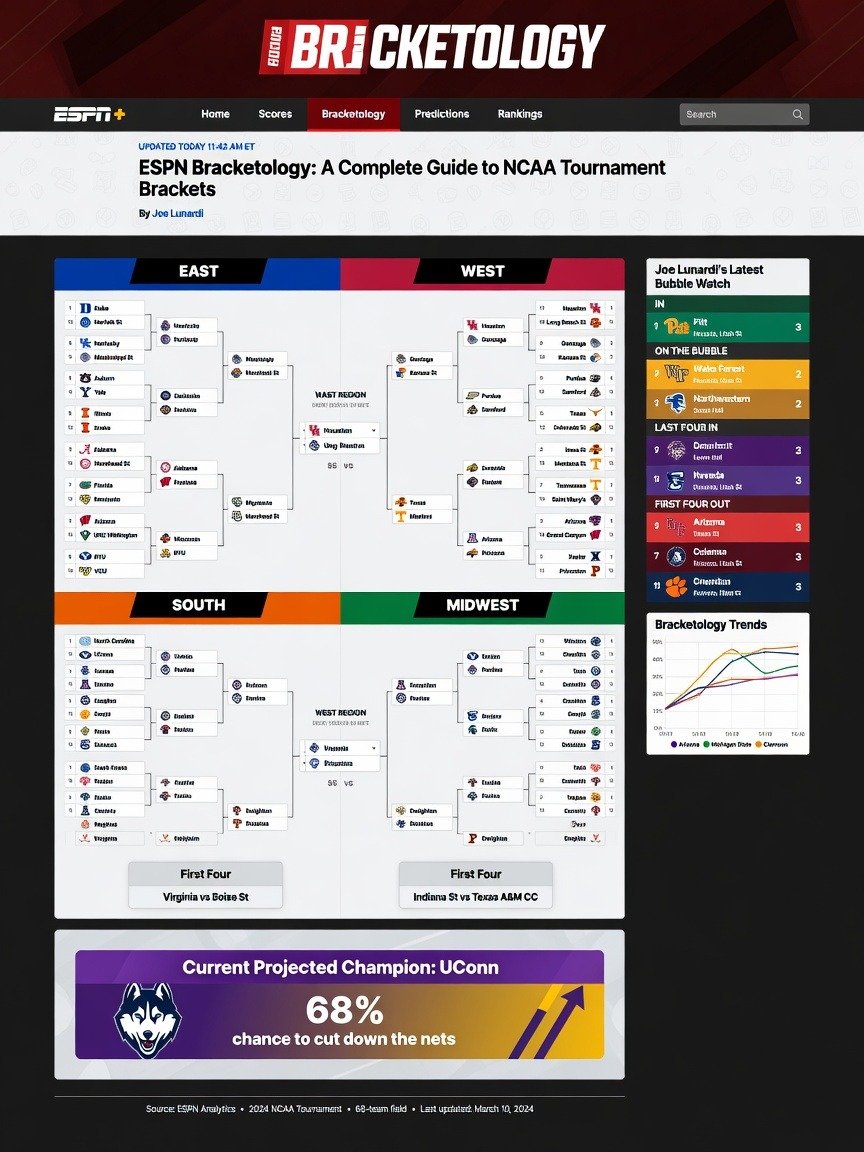
ESPN bracketology is a popular topic among college basketball fans. It helps fans follow the NCAA Tournament picture before the official bracket is announced.
During the season, teams play many important games. Their results can change how people view the tournament field. Therefore, bracket projections can change from week to week.
In simple words, bracketology is about predicting which teams could make the NCAA Tournament. It also looks at where those teams could be placed in the bracket.
This guide explains ESPN bracketology in easy language. You will learn about seeds, bubble teams, tournament resumes, regions, and bracket predictions.
You will also learn how ESPN Tournament Challenge works. This can help you understand the difference between a projected bracket and your personal tournament bracket.
What Is ESPN Bracketology?
ESPN bracketology refers to projected NCAA Tournament brackets. These projections show which teams could make the tournament and where they might be seeded.
A projection is not the same as the official bracket. The NCAA Tournament field becomes official through the NCAA selection process.
Therefore, fans should think of bracketology as a way to follow the tournament picture. It gives fans something to discuss before the real bracket arrives.
The projected field can change after important games. A strong win may improve a team’s position. A tough loss may create new questions about that team.
Why Is ESPN Bracketology Popular?
College basketball has a long season. Teams play many games against different opponents.
Because of that, fans have many chances to discuss tournament possibilities. They want to know which teams look ready for March Madness.
ESPN bracketology gives fans a simple way to follow those discussions. It can make regular-season games feel even more important.
The topic also becomes more interesting near the end of the season. Conference tournaments can change the picture quickly.
How Does ESPN Bracketology Work?
Bracketology starts with the current college basketball field. Analysts study teams and consider their overall results.
They then create a possible tournament field. Teams receive projected seeds and positions in different regions.
However, the projection can change. New games create new information, so bracketologists must keep updating their work.
This is why an ESPN bracketology projection should not be treated as a final answer. It is a snapshot of the tournament picture at that time.
What Is an NCAA Tournament Bracket?
The NCAA Tournament bracket shows the teams that will compete for the national championship.
The bracket divides the tournament into regions. Teams play through several rounds.
The tournament includes the First Four, First Round, Second Round, Sweet 16, Elite Eight, Final Four, and championship game.
Each round removes teams until only one remains. That team wins the national championship.
The bracket gives fans a simple way to see the path each team could take.
What Does a Seed Mean?
A seed is a number given to a team in the tournament.
Each region traditionally contains seeds from No. 1 through No. 16. The No. 1 seed sits at the top of its region.
A lower seed number generally means the team received a higher position in the field.
However, seeds do not guarantee results. Tournament games can produce surprising outcomes.
That is one reason March Madness attracts so much attention. A team with a lower seed can defeat a higher-seeded team.
What Is a No. 1 Seed?
A No. 1 seed is one of the top teams in a tournament region.
The men’s NCAA Tournament has four traditional No. 1 seeds. Each one leads a different region.
Teams competing for those spots receive plenty of attention during the season.
Their records, important wins, losses, and overall performance can all become part of the discussion.
Therefore, ESPN bracketology often focuses heavily on teams that could receive top seeds.
What Is a Bubble Team?
A bubble team is a team close to the tournament selection line.
Some teams appear safely inside the projected field. Others sit safely outside.
Bubble teams fall somewhere between those groups. Their tournament position can depend on upcoming results.
A big win can help a bubble team. A bad loss can create more concern.
That makes bubble teams some of the most interesting teams to watch late in the season.
What Does “On the Bubble” Mean?
When someone says a team is “on the bubble,” they mean its tournament position is uncertain.
The team may have enough good results to remain in the discussion. However, it may also have weaknesses that create questions.
For example, a team might have many good wins but several poor losses.
Another team might have a strong record but fewer chances against high-level opponents.
These details make ESPN bracketology more than a simple win-and-loss count.
What Is a Tournament Resume?
A tournament resume is the collection of results that shows what a team has done during the season.
It can include wins, losses, opponent quality, road games, home games, and other results.
Think of it like a student’s report card. One test does not tell the whole story.
In the same way, one basketball game does not usually explain an entire team’s season.
The full resume gives more information about the team’s body of work.
Why Do Quality Wins Matter?
Not every win happens against the same level of competition.
Beating a strong opponent can give a team an important result. It can show that the team can compete against difficult competition.
A win away from home can also provide useful context.
This does not mean one win automatically changes a team’s entire tournament position. Analysts usually look at the complete season.
Why Do Bad Losses Matter?
Losses are also part of a team’s resume.
A team can lose games and still make the NCAA Tournament. However, the circumstances around those losses can matter.
For example, analysts may look at the opponent and location.
They may also look at how the team performed throughout the season.
Therefore, one loss does not always tell the complete story.
What Is Strength of Schedule?
Strength of schedule describes how difficult a team’s opponents have been.
A team that plays many strong opponents has more chances to prove itself.
Another team might have a very good record but face fewer difficult opponents.
That difference can make tournament discussions more complicated.
When reading ESPN bracketology, it helps to understand that overall records do not always tell the entire story.
What Are Quadrant Records?
College basketball fans often hear about Quad 1, Quad 2, Quad 3, and Quad 4 results.
These categories group games based on factors such as opponent strength and game location.
Quad records can help people understand a team’s schedule in more detail.
They are one part of the larger tournament resume.
Therefore, fans should use them as helpful information rather than treating one number as the entire story.
Home Games, Road Games, and Neutral Games
Where a game happens can matter in college basketball.
A home game gives a team its usual home environment. A road game places the team in the opponent’s arena.
Neutral-site games happen at locations that are not the normal home court for either team.
These different settings can provide different challenges.
As a result, bracket discussions often include game location when looking at team resumes.
How Teams Move in ESPN Bracketology
Projected seeds can move during the season.
A team might move higher after several strong results. Another team might move lower after difficult losses.
However, movement is not always simple.
A team can win while other teams around it also win. Therefore, its projected position might not change much.
This is why ESPN bracketology should be viewed as a changing picture rather than a fixed ranking.
Why Conference Play Matters
Conference games can be very important.
Teams play familiar opponents several times during a season. Conference records can also help show how teams perform against regular competition.
Strong conference results can become part of the overall tournament discussion.
However, conference performance is only one part of the bigger picture.
Analysts still consider the full schedule and the team’s results outside conference play.
How Conference Tournaments Affect Bracketology
Conference tournaments arrive near the end of the regular season.
They give teams more chances to play important games.
A team can improve its position with strong results. Another team can create new questions with a loss.
Conference tournament champions can also earn automatic tournament bids under the applicable conference qualification process.
This makes conference tournament week especially important for ESPN bracketology discussions.
What Is an Automatic Bid?
An automatic bid is a tournament spot connected to a conference’s qualification process.
Conference tournaments can play an important role in determining these spots.
The exact process can differ based on the conference and NCAA rules.
Automatic bids are different from at-large bids.
Understanding this difference makes the tournament selection process easier to follow.
What Is an At-Large Bid?
An at-large bid is a tournament spot awarded to a team that does not enter through an automatic conference qualification route.
There are more teams competing for these spots than there are available positions.
That creates a lot of discussion around bubble teams.
It also explains why bracketology becomes especially interesting near the end of the season.
What Are Regions?
The NCAA Tournament bracket divides teams into regions.
Each region creates a possible path toward the Final Four.
Teams must win games to move through their region.
Eventually, the regional winners advance to the Final Four.
The region structure helps fans understand the possible path from the opening rounds to the national championship.
What Is the Sweet 16?
The Sweet 16 is the round that features 16 remaining teams.
At this point, the tournament has already eliminated many teams.
The remaining teams are divided across the tournament regions.
Games become even more important because one loss ends a team’s tournament run.
The Sweet 16 is one of the most watched stages of March Madness.
What Is the Elite Eight?
The Elite Eight comes after the Sweet 16.
Eight teams remain in the tournament at this stage.
The winners advance to the Final Four.
The Elite Eight includes regional final games. Therefore, every game decides which team continues toward the national championship.
What Is the Final Four?
The Final Four features the four teams that remain after the regional rounds.
These teams then play in the national semifinals.
The winners advance to the championship game.
The Final Four is one of the biggest parts of the NCAA Tournament.
It is also the stage where earlier bracket predictions are tested.
ESPN Bracketology vs. an Official Bracket
This difference is very important.
ESPN bracketology represents a projected tournament field. It is created before the official field is announced.
The official bracket comes through the NCAA selection process.
Therefore, a projected No. 5 seed could become a No. 6 seed in the official bracket.
A team projected into the tournament could also miss the field.
That is normal because projections are not official selections.
How ESPN Tournament Challenge Works
ESPN Tournament Challenge lets fans create their own tournament brackets.
ESPN says users must create a bracket entry before joining a Tournament Challenge group. Picks become available after the tournament field has been set and the entry timer reaches zero.
This is different from bracketology.
Bracketology looks at a possible field before the official bracket. Tournament Challenge lets users make their own selections after the tournament field is available.
How to Create an ESPN Bracket
Creating an ESPN Tournament Challenge bracket is simple.
First, log in to your ESPN account. Then open the Tournament Challenge area and select the option to create a bracket.
ESPN’s current support guide says the process works for both men’s and women’s Tournament Challenge entries.
After creating your entry, you can make your selections when the picks become available.
Remember that brackets lock when the tournament begins. ESPN says entries and bracket changes must be completed before the first game tips off.
How ESPN Bracket Scoring Works
ESPN Tournament Challenge uses points to track bracket performance.
Each round has a different point value. Later rounds are worth more points than earlier rounds.
ESPN’s support information lists a total of 1,920 possible points across the 63 games following the First Four in its standard scoring explanation.
This system rewards correct picks as the tournament moves forward.
Therefore, a strong bracket needs more than a few correct early picks.
What Is the ESPN Leaderboard?
The leaderboard shows how brackets compare during the Tournament Challenge.
ESPN explains that brackets accumulate points as games are completed. The leaderboard then shows ranking information and percentile information.
This lets fans see how their bracket compares with other entries.
It can also make the tournament more fun when friends and family compete in groups.
How to Join an ESPN Bracket Group
You need a bracket entry before joining a Tournament Challenge group.
ESPN’s current instructions say users can go to My Groups and select the option to create or join a group.
After finding the group, you can select the bracket you want to enter.
Group creators can also control the number of entries allowed per user.
What Happens If Your Bracket Performs Poorly?
A poor start does not mean you cannot enjoy the tournament.
ESPN also offers a Second Chance Challenge for certain Tournament Challenge games.
For the 2026 men’s competition, ESPN listed the Second Chance bracket as opening after the tournament began and closing at the first game of the Sweet 16.
Dates can change each year. Therefore, check the current ESPN rules for the season you are following.
Why Bracketology Changes So Often
College basketball can change quickly.
Teams play new games every week. Those games add new information to the tournament picture.
A team can also be affected by what other teams do.
For example, one team may win while another bubble team loses.
As a result, ESPN bracketology can change even when you are following the same group of teams.
Why March Madness Is Hard to Predict
March Madness is famous for surprises.
Higher-seeded teams can lose. Lower-seeded teams can advance.
That uncertainty makes tournament brackets exciting.
It also means that bracketology should not be treated as a guarantee.
A projection explains how the field looks at a certain point. It does not decide what will happen on the court.
How to Read ESPN Bracketology
Start by checking the date of the projection.
An older projection may not include the newest games.
Next, look at the projected seeds. Then check which teams are listed near the bubble.
You can also study recent results and important wins.
Finally, remember that different analysts may create different projections.
Common Bracketology Terms
Here are some useful terms:
- Bracket: The tournament structure.
- Seed: A team’s position in the field.
- Bubble team: A team close to the selection line.
- Automatic bid: A tournament place connected to conference qualification.
- At-large bid: A place awarded outside automatic qualification.
- Region: A section of the tournament.
- Resume: A team’s collection of important season results.
- Sweet 16: The round with 16 remaining teams.
- Elite Eight: The round with eight remaining teams.
- Final Four: The four remaining teams.
These words make ESPN bracketology easier to understand.
Common Mistakes When Following Bracketology
One common mistake is thinking a projected bracket is official.
It is not. The official tournament field comes later.
Another mistake is looking only at the win-loss record.
A team’s schedule contains more information. Opponent quality and game location can also matter.
Finally, avoid judging a team’s entire season from one game.
Bracketology usually considers the full body of work.
Tips for Following ESPN Bracketology
Check updates regularly during the important part of the season.
However, do not worry about every small movement.
Instead, look for larger changes. Watch teams that move around the bubble.
Also, pay attention to conference tournament results.
Most importantly, remember that projections are temporary. The official bracket will eventually replace them.
ESPN Bracketology and College Basketball Fans
Bracketology gives fans another way to enjoy college basketball.
It creates conversations about teams, seeds, schedules, and tournament possibilities.
It can also make regular-season games more interesting.
A game between two bubble teams may receive extra attention because both teams have something important to prove.
That is why ESPN bracketology remains a popular part of the March Madness discussion.
How to Use Bracketology Before Making Your Bracket
Once the official bracket arrives, you can study each matchup.
Look at the teams and their season results.
Then, consider how each team performed against strong competition.
You can also consider recent form and injuries when making your own decisions.
However, your ESPN bracket should be your own set of picks. Bracketology can provide information, but it does not make those picks for you.
Frequently Asked Questions About ESPN Bracketology
What is ESPN bracketology?
ESPN bracketology is a projected NCAA Tournament bracket. It shows teams that could make the tournament and possible seed positions.
Is ESPN bracketology official?
No. Bracketology is a projection. The official tournament field comes through the NCAA selection process.
What is a bubble team?
A bubble team is a team near the line between making and missing the projected NCAA Tournament field.
Can I make my own ESPN bracket?
Yes. ESPN Tournament Challenge allows users to create their own bracket entries and make tournament picks after the field becomes available.
Can I join an ESPN bracket group?
Yes. ESPN allows users to join Tournament Challenge groups after creating a bracket entry.
Conclusion
ESPN bracketology gives college basketball fans a useful way to follow the NCAA Tournament picture before the official bracket arrives.
It helps explain seeds, bubble teams, regions, tournament resumes, and possible bracket positions.
However, a projected bracket can change. Teams keep playing games, and every new result adds information.
That is why fans should check the date of a projection before using it.
ESPN Tournament Challenge is a separate experience. It allows fans to create their own brackets and compete with friends or other groups. ESPN currently supports both men’s and women’s Tournament Challenge games.
Ultimately, bracketology is about following the journey toward March Madness. It gives fans a simple way to understand the tournament picture.
Once Selection Sunday arrives, the projected field gives way to the official bracket. Then the real games begin, and every team gets its chance to compete.